

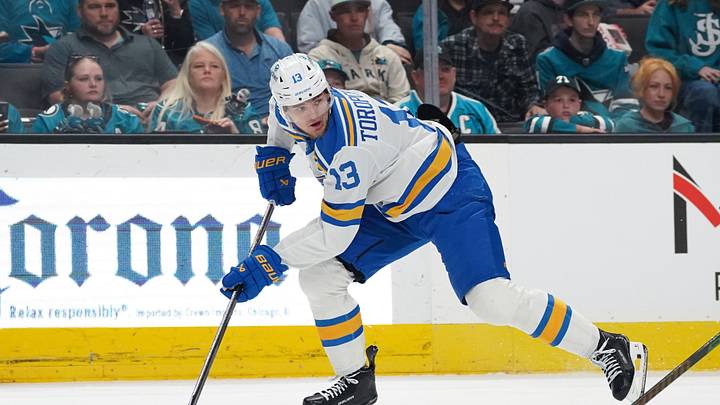
Every successful NHL roster needs players who are willing to do the dirty work. Over the past few seasons, Alexey Toropchenko has made that role his with the St. Louis Blues. With a new two-year, $5 million contract extension kicking in for the 2026-27 season, the Blues have rewarded the physical, defensive-minded approach to his game that Toropchenko brings each night.
While his 14-goal season in 2023-24 would be a welcome bonus, it is hard to believe that level of offensive production will return any time soon. For the coming season, expect his job responsibilities to heavily rely on defensive zone starts, penalty killing, and using his 6-foot-6 frame responsibly. Heading into training camp, however, the question should not be whether he can score, but whether he can reclaim the dominance he once had in those heavy minutes.
A heavier checking role with fewer results
To evaluate a player like Toropchenko properly, you have to look beyond just goal scoring. The primary responsibilities of a fourth-line player lie heavier in penalty-killing and physical matchups against the opposition. Over the past three seasons, the coaching staff has trusted him with an increased amount of shorthanded responsibilities. The problem, however, is that as his workload grew, Toropchenko's overall effectiveness on the ice took a step back.
In 2023-24, the Russian forward was credited with 84:12 of shorthanded ice time, then 92:54 in 2024-25, and 106:30 last season. During the 2024-25 season, he was a force to be reckoned with, logging 223 hits, dominating in the defensive zone, and controlling the pace of play when his team was down a man. However, that increased workload has seen his recorded hit totals drop to 132, and the Blues surrendered more pressure with him on the ice. His overall gameplay, regardless of injury, has noticeably softened.
The minutes are no longer reserved
Despite the rising salary cap and cost of player contracts, the reality of the situation is that the Blues have depth options who can provide the club with defensive and physical efforts each game without costing $2.5 million against the salary cap. Veterans like Nathan Walker, Pius Suter, and Oskar Sundqvist have already proven they can play a strong defensive game, but could also experience some regression themselves.
The true pressure will come not from outside the organization, but just outside of the team as younger talent pushes from within the system. Prospects like Otto Stenberg have already shown they are capable of playing in Jim Montgomery's system and can be trusted with and without the puck. Aleksanteri Kaskimaki is coming off of a 44-point season in the AHL, and Dylan Peterson offers a 6-foot-4 frame with physical energy, similar to a former Blues captain, David Backes.
At this point, training camp will not be about whether Toropchenko can rediscover his scoring touch. Camp will likely be a gauge of whether he can consistently win his starting role on the penalty kill, his physical identity on the forecheck, and make the fourth line a nightmare for opponents to play against. If he brings that physical edge back to the ice, his new contract makes sense for the roster. However, if his game stays quiet, the Blues could be forced sooner rather than later to look at cheaper options to take his ice time.
 Add us as a preferred source on Google