

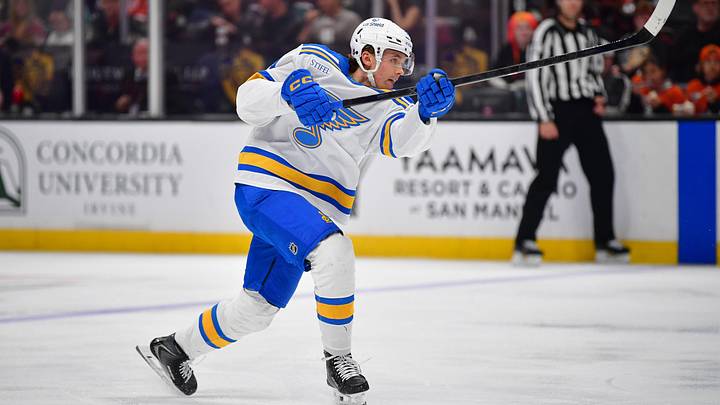
We conclude our look back at the history of picks that the St. Louis Blues will be making at the NHL draft in a couple weeks by breaking down the 29th-overall pick. Historically, it has...not been a good pick, with very few players actually having NHL careers--but it does make for a great game of "remembering some guys." Before diving in, revisit our breakdown of the 11th-overall pick (this could really go the Blues' way!) and the 15th-overall pick (also not too bad!).
2005: Steve Downie (RW), Philadelphia Flyers
We kick off the list with undersized forward Steve Downie, a journeyman who played over 400 NHL games and finished with 196 points. If the Blues can get a solid enough bottom-six forward like Downie, that's basically a win.
2006: Chris Summers (D), Phoenix Coyotes
We're gonna see a pair of now-defunct franchises in the early goings here, so that's fun. Summers, meanwhile, played 70 NHL games over six seasons, mostly as an AHL call-up option.
2007: Jim O'Brien (C), Ottawa Senators
Like Summers, O'Brien played just 77 NHL games over five seasons., scoring a meager 13 points in that time.
2008: Daultan Leveille (C), Atlanta Thrashers
One reason the Thrashers may've struggled? Their picks were duds--or at least found their next level with other teams. Leveille played zero games in the NHL and, two picks after him, the Florida Panthers selected Jacob Markstrom. Oops!
2009: Carter Ashton (RW), Tampa Bay Lightning
Another team that struggled for a long time, Ashton never played for Tampa; he got 54 games with the Toronto Maple Leafs, registering only three points--all assists.
2010: Emerson Etem (RW), Anaheim Ducks
Etem got a respectable 173 games during his career, tallying 46 points. As far as AHL call-up options went, he wasn't too bad. The whiff, though, is the player who went 30th-overall: Brock Nelson, who recently passed 1,000 games and has scored 652 points, over 300 of them goals.
2011: Nicklas Jensen (RW), Vancouver Canucks
Another instance where the player taken immediately after turned into a top-of-the-lineup guy, Jensen played a paltry 31 NHL games. The Canucks probably regret not taking Rickard Rakell, who's played over 860 games scored 567 points.
2012: Stefan Matteau (C), New Jersey Devils
Matteau bounced around the NHL, amassing 92 games with five organizations. If it hasn't become clear at this point, the 29th-overall pick doesn't usually bring the juice.
2013: Jason Dickinson (C), Dallas Stars
This may be the first 29th-overall pick who's had any kind of valuable impact. Dickinson has played 566 games and scored 172 points, which is a solid return on a late first-round pic. The downside, though, is that Ryan Hartman went next, and he's arguably had the better career.
2014: Adrian Kempe (RW), Los Angeles Kings
Now we get the big one. Kempe is probably the best 29th-overall pick in this entire exercise: he's scored 230 goals and 474 points in 711 games, and just signed a massive, $10.625-million AAV extension with the Kings through 2034. That's a home run selection for a team that just won Stanley Cup the season prior.
2015: Gabriel Carlsson (D), Columbus Blue Jackets
In the loaded 2015 draft, a defenseman who only played 81 games is a bit of a bust; most of that year's second-round selections played more games than Carlson did.
2016: Trent Frederic (C), Boston Bruins
It's at about this point in history that late first-round selections start to have more consistent NHL impact--no surprise that it coincides with the rise of the analytics era. Frederic isn't a star by any means, but he's a solid enough bottom-six forward with 412 games played.
2017: Henri Jokiharju (D), Chicago Blackhawks
An unflashy but solid enough defenseman, Jokiharju's a pretty good No. 5 defenseman with penalty kill ability. If you're getting an every night player this late in the first round, you're doing well.
2018: Rasmus Sandin (D), Toronto Maple Leafs
It took a few years, but Sandin has really found his game with the Washington Capitals. He's a good second-pair defenseman who's got a respectable 145 points in 382 games.
2019: Brayden Tracey, (LW), Anaheim Ducks
And we crash back down again here: Tracey has played only one NHL game.
2020: Brendan Brisson (C), Vegas Golden Knights
We're crossing into "too early to judge" territory, as these later picks often take more time to develop. Brisson, though, has only played 27 NHL games; it's a bad look when Mavrik Bourque--a key part of the Dallas Stars' forward group--was taken with the next pick.
2021: Chase Stillman (RW), New Jersey Devils
Stillman has yet to play an NHL game, though the outlook probably isn't too good at this point as he toils away in the AHL.
2022: Maveric Lamoureux (D), Arizona Coyotes
There's a ways to go in Lamoureux's development, but a 6-foot-6 defenseman with a good chance of being a third-pair guy is a good bet to make with the 29th-overall pick.
2023: Theo Lindstein (D), St. Louis Blues
Hey, we know this guy! Lindstein has quite a lot of work to do to become an NHL regular, but he had a solid enough showing last season to make us think there's a No. 4/5 defenseman in there.
2024: Emil Hemming (RW), Dallas Stars
Hemming hasn't played in the NHL yet, but he's a solid enough wing prospect who's turning pro next season.
2025: Mason West (C), Chicago Blackhawks
If you want to talk about late-round gambles, this was a big one for the Hawks: West was, at the time, the quarterback for his school's football team, and wanted to chase a championship with them before committing to hockey. True to his word, he's headed to Michigan State next year to play hockey; West is a great example of why teams with extra first-round picks can afford to take these sorts of risks.
It's a tough outlook for the Blues with the 29th-overall pick. There could be some really exciting boom/bust prospects available here and, if the Blues play it safe with picks 11 and 15, they should look to take a swing on one of those players who could fit in the top of the lineup a few years from now. Without a second-round pick this summer, they shouldn't play it safe at 29.
 Add us as a preferred source on Google