

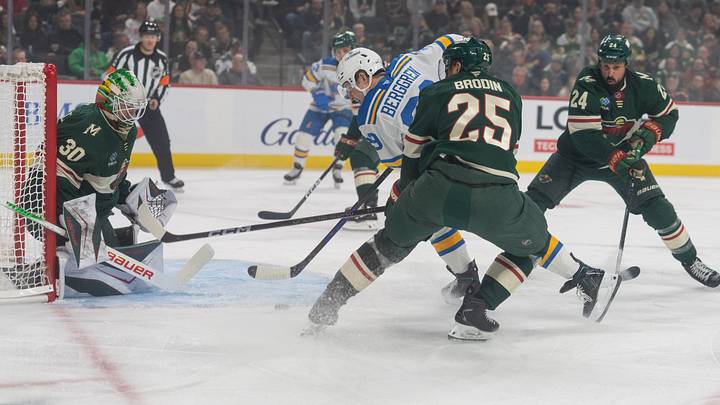
Entering this season, expectations for the St. Louis Blues were to push for the playoffs and compete for one of the two Western Conference wild-card spots. It was understood around the league that the gap between the top teams in the central and the next tier, which included the Blues, was seismic and was going to be hard for the Blues to close in on this season. However, with a season-opening win over the Dallas Stars, the Blues thought that sentiment might finally have shifted in their favor. Then the team got throttled the following night in Colorado, 6-1, and the gap between the contenders and the Blues became even clearer.
The Blues had another chance to change that narrative Thursday night in St. Paul against the Minnesota Wild, a team that, despite a hot start, was missing seven regular starters, including three of its top four defensemen and its highest-paid goaltender. Instead, the Blues failed to show up in the first two periods, took five penalties against the league's best power play, and led a comeback effort that came too late in a 5-4 road loss. A pattern and narrative all too familiar to the Blues over the last few seasons. With the season still in its infancy, the hope is that the patterns showing up early this season can be corrected rather than signaling continued struggle against the league's best.
Outskated and outmatched
Coming into Minnesota, the Blues had won back-to-back games and looked to be trending in the right direction, led by new additions Connor McMichael and Mason McTavish. With the "McDouble line" driving the offense and one of the league's best penalty-kill units, the team was over .500 and poised to string together some wins. The team hoped their last two wins signaled what's to come for the rest of the season. The game started exactly how the Blues would hope, with Jonatan Berggren scoring an early power-play goal in the first two minutes to give the Blues the lead. Momentum shifted quickly when the Blues took back-to-back penalties, giving the Wild a two-man advantage that tilted the ice in their favor and led to a power-play goal.
The Blues never got control of the puck for the rest of the period, and the score would have been much worse than 2-1 if goaltender Joel Hofer hadn't stood on his head and made spectacular saves to keep the Wild's lead at one. The Wild dominated the Blues with speed, crisp passing, and relentless offensive pressure, a theme eerily similar to the 6-1 loss the Blues had to the Avalanche in the first week of the season. Even a Mason McTavish equalizer to start the second period didn't hold up, as the Wild immediately regained the lead less than a minute later on the ensuing shift. The Wild built a commanding 5-2 lead by the end of the period through constant pressure and dynamic playmaking from their top line. The Blues rarely had any puck possession or time in the offensive zone.
More of the same
The Blues made the game interesting in the final ten minutes, with a short-handed goal by Robert Thomas and a goal by Dylan Holloway in the final minute, but the story remains one Blues fans know all too well: failing to play a full sixty minutes costs the team two points. While the continued effort and determination to fight back into the game late is a positive sign that this team does not give up, the performance in the first two periods, filled with careless, irresponsible penalties and careless turnovers, is a habit the Blues have to break, especially against the top teams in their division.
The Wild controlled the pace and puck for most of the game, much like the Avalanche dominated the Blues in the first week of the season. Unlike the game in Denver, the team at least came together and put in a third-period effort that it can build on in its next several games. That said, if the Blues want to join the conversation with the Avalanche, Wild, Stars, and even the rising Utah Mammoth, they must play a consistent full sixty minutes of hockey. If they don't cut down on turnovers and win puck battles, the gap between them and the tier above them in the division will only grow.
 Add us as a preferred source on Google