

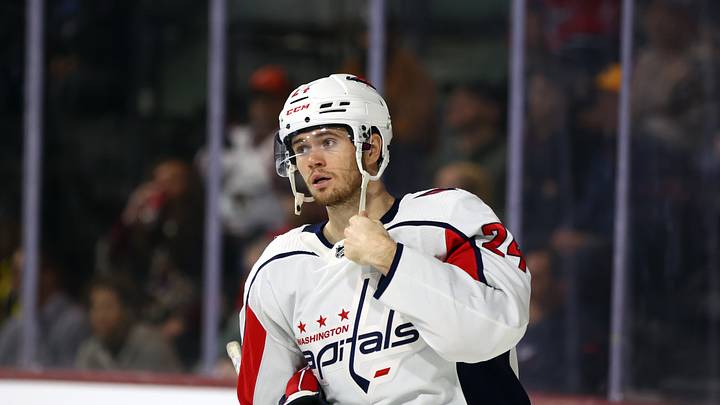
When the St. Louis Blues hit the 2026 offseason, there was a clear sign of unfinished business, a desire to get better, increase internal competition, and make uncomfortable changes in the attempt to bring their team back to contention for another championship. One of the corresponding moves to fuel these desires was moving on from long-time forward Jordan Kyrou and moving him to the Washington Capitals in exchange for forward Connor McMichael, a 2026 first-round draft pick, and forward prospect Milton Gastrin.
The move signaled a fundamental shift for the Blues' retool and a message to the locker room that the team's front office was not looking for a middle-six band-aid, but a long-term fixture of their forward core. McMichael, 25, is entering his prime not only with runway ahead of him, but 315 NHL games under his belt. The Blues acquired the forward under an RFA status and ultimately came to a six-year, $40.5 million agreement. With his new contract, McMichael is a player who will be looked to help lead the team back to the postseason, but is far from a finished product.
How the Blues help develop McMichael
To get McMichael back to and past his 26-goal, 57-point production he reached in the 2024-25 season, the Blues must encourage him to return to his finisher's mindset. There is a clear connection in his metrics, showing that good things happen when he is selfish with the puck and shows a willingness to shoot the puck, rather than looking for the open man and passing off the shot.
During his 26-goal run in 2024-25, McMichael generated 177 shots on goal and 321 total shot attempts. He routinely attacked the high-danger areas, cashing in on his deceptively quick release. Last season, however, McMichael fell into a pass-first mentality, and his shot on goal total fell off a cliff by over 20 percent. Despite the stark drop, it is important to note that his five-on-five assists did rise from 22 to 26, so some good came from the deferral. He was actively looking for pass options rather than pulling the trigger himself. With his offensive metrics taking a hit, McMichael's five-on-five shooting percentage went from 14.8 percent to 10.5 percent, leaving the forward slipping down the Captials points leaders.
In Montgomery's system, McMichael will need the green light to shoot. If he restores his shot volume to his 2024-25 levels, a natural rebound toward his career shooting average should push him back over the 20-goal threshold, with the potential even for 30.
Settling the positional debate
For the past few seasons, Washington cycled McMichael between the center and wing positions. The young forward has shown that he is not a poor center by any means. He has shown he is capable of playing a defensively sound, 200-foot game, making him a viable option up the middle in a pinch. However, diving deeper into the numbers, it is becoming clearer that McMichael is better utilized on the wing.
Over his young career, McMichael currently carries a 43 percent faceoff win rate. When the Capitals used him as a center, he logged 795 draws, winning 42.4 percent of his attempts. Over the last two seasons, he has been shifted to the wing, which has helped him to move away from his faceoff duties and allowed him to use his speed and active stick to disrupt opposing breakouts. Penciling McMichael on the wing with a strong center, potentially Mason McTavish, the Blues can help him move his focus from draw responsibilities and instead focus on the other areas of his game.
McMichael on the man-advantage
With most teams around the NHL, there are plenty of mouths to feed on the power play. The top power play structure has been focused on and revolved around Alexander Ovechkin's signature one-timer, with players like John Carlson on the point and Dylan Strome looking to cash in. That dynamic left McMichael fighting for leftover scraps on the second unit that averaged a limited 1:40 of time on the man-advantage.
While he will need to contend with top offensive threats in St. Louis as well, McMichael could find a completely different level of success based on the scheme and talent surrounding him. Rather than deferring to aging veterans who demand the puck, McMichael can complement a younger, highly skilled core in his own age bracket that could gel better with one another. Placing him on the second unit alongside players like Dylan Holloway and McTavish gives Montgomery a group with speed and reliability.
Giving McMichael structured, consistent minutes on that second unit where he can be counted on as a primary scoring option, rather than a secondary option, should allow him to tap into that remaining runway and push his point totals to new career marks.
At 25, McMichael's best hockey should still be in front of him. He did not lose his goal-scoring touch last season, but has seemingly fallen victim to a variance in his shooting percentage, a pass-first mentality, and positional juggling. Anchoring him on the wing, providing consistent power play deployment, and a green light to shoot the puck, the Blues have a player capable of returning to his identity as a legitimate scoring threat and a steal of a player for years to come.
 Add us as a preferred source on Google