

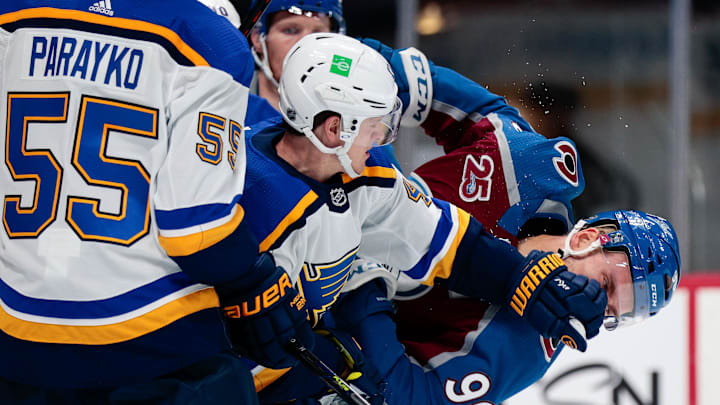
Yesterday, there were reports of a trade involving St. Louis Blues defenseman Colton Parayko and the Buffalo Sabres, and the return for St. Louis would've been a massive step in furthering the rebuild. Instead, Parayko declined to waive his No-Trade Clause--as is his right--and will remain, at least for now, a member of the Blues. Fans may be upset by Parayko's decision to stay, but their ire would be misdirected: GM Doug Armstrong is the one who put trade protections on the defenseman's contract in the first place, and we've seen this come back to bite him before.
Almost three years ago, the Blues tried to execute a trade with the Philadelphia Flyers that would've sent Torey Krug and a first-round pick to Philadelphia in exchange for Travis Sanheim and Kevin Hayes. Krug invoked his NTC and, in the end, the Blues sent a sixth-round pick to the Flyers for Hayes, who the Flyers retained 50 percent on. Unfortunately, injuries have since ended Krug's NHL career, though one more season remains on his contract.
Armstrong is notorious for handing out trade protections to the players he signs: a quick look at the Blues' roster on Puck Pedia shows four players with full no-trade protections, and an additional four with partial trade protections, though Cam Fowler's becomes a full NTC on July 1 this summer. Armstrong also has a habit of extending players well before he actually needs to, as we've seen with Fowler and Pavel Buchnevich.
Generally, trade protections are given to players who are either integral members of the team (think leadership or star producers), or as part of a compromise to reduce the cap hit of a contract. They should not be handed out lightly, because it creates situations where players like Krug and Parayko are made to be the bad guy for exercising the rights within their contract when, in reality, management was too cavalier giving out trade protections. Trade clauses also limit roster flexibility, as the Blues are at a disadvantage in any trade negotiations involving players who have them.
Leaking that a player's been traded before they've signed off on it once is a mistake, as with Krug. Doing it a second time is an embarrassment. The Blues didn't learn anything the first time, and erred again with the mishandling of Parayko. It's a bad look, one that risks tarnishing Armstrong's legacy, that hopefully the incoming front office doesn't repeat in the future.
 Add us as a preferred source on Google