

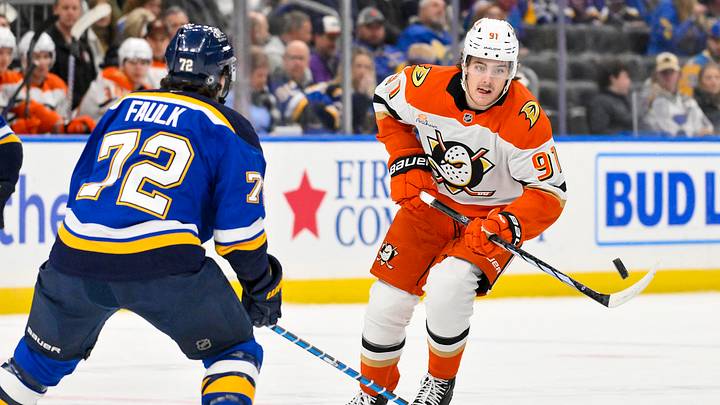
Almost two years ago, the St. Louis Blues rocked the NHL by tendering dual offer sheets to then-Edmonton Oilers restricted free agents Philip Broberg and Dylan Holloway. It was a gutsy move that broke the unspoken rules around offer sheets, and it's worked out better than anyone could've hoped for the Blues: both Holloway and Broberg have signed long-term extensions in St. Louis, and both have blossomed into true top-of-the-lineup difference-makers. Had Mavrik Bourque made it to free agency, the Blues should've tried it again with him, too.
In a way, those two offer sheets kicked off this summer's utter madness--but let's look at how they impacted last summer first.
The Carolina Hurricanes, now Stanley Cup Champions, traded for K'Andre Miller and signed him to an eight-year, $7.5-million AAV contract; in return, the New York Rangers got a first- and second-round pick, and defenseman Scott Morrow. It was the threat of an offer sheet that propelled that deal across the finish line, though it was ultimately unnecessary.
In the last week, we've seen two offer sheets: one tendered by the New Jersey Devils to Barrett Hayton after trade talks with the Utah Mammoth broke down, and then a league-resetting bombshell came through a couple of days later. The Philadelphia Flyers tendered a five-year, $18-million AAV contract to rising Anaheim Ducks star Leo Carlsson that makes him the highest-paid player in the NHL. The Flyers will be required to give up four first-round picks if the Ducks do not match, and they have until Friday to make a decision.
As the cap rises, it's becoming clear that free agency is dead. Teams usually have ample cap space to retain players--gone are the COVID days when contenders had to shed contracts in order to stay compliant with the stagnant cap. That means trades are the best way to get high-end talent, but franchises rarely let star players go; when they start demanding to leave the way Dylan Larkin is in Detroit, that's a symptom of a poorly run organization more than anything.
That leaves offer sheets as the primary way to obtain young, star-level talent (outside of draft and development, of course). The Blues saw that coming two years ago and took advantage of an Oilers team that pressed itself to the cap ceiling and took for granted that their RFAs would accept the lowball contracts and minuscule opportunities that were handed them.
Young players are taking more control of their NHL futures than ever. What the Blues did is no longer going to be an exception and could become the norm; general managers will have to learn to lock up their RFAs before there's even a risk of an offer sheet. Credit the Blues for kicking off that new normal.
 Add us as a preferred source on Google