

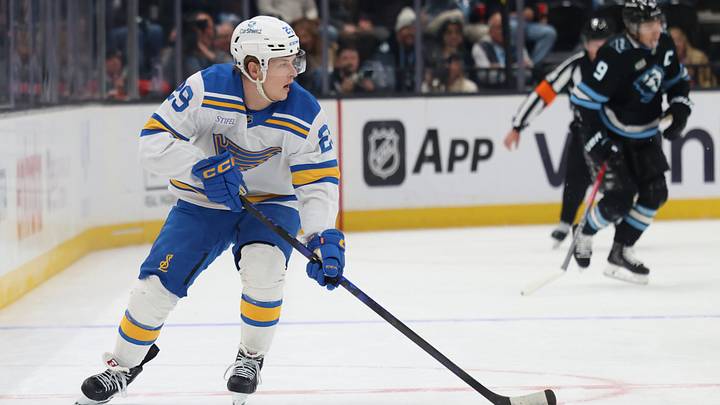
The St. Louis Blues made quite a few transactions this summer, from signings to trades to a boatload of draft picks. Add in a front office transition from Doug Armstrong to Alex Steen as general manager, and it was one of the Blues' busier summers.
Not all of these moves should be treated the same, though, as many will have zero impact on next season while others could be the top story of the season. Let's rank 'em!
7. AHL depth signings
Every team needs organizational depth, and the Blues are no different. At the start of June, Armstrong signed all of Will Cranley, Zach Dean, and Dylan Peterson to one-year, league minimum extensions, and goaltender Georgii Romanov to a two-year extension. None of these players project to make an impact in the NHL, but they should play key roles with the Springfield Thunderbirds.
6. Contract extensions for depth players
Jonatan Berggren and Oskar Sundqvist got one-year extensions, and both will be depth players for the Blues next year. Neither one moves the needle, and the AAVs are low, so these are nearly irrelevant.
5. Free agency signings
The Blues weren't particularly active in a weak free agency class, and only two players of note got NHL contracts: Ross Johnston and Dillon Dube. These are more impactful than the contract extensions to Berggren and Sundqvist, in their own way.
First up is Johnston, who got a three-year, $2-million AAV contract as a 32-year-old. Let's be clear: Johnston is not a good hockey player. In 307 games, he has 14 goals, 46 points, and 579 penalty minutes; he is here to fight, and that is a ridiculous cap hit for a player who does little else on the ice.
Next is Dube, who was one of the five indicted Hockey Canada players. One of the other players, Cal Foote, recently signed a contract in Sweden but, two days later, it was terminated after pushback from fans. There's already fan discontent over the signing of Dube, and it's likely going to be a storyline throughout the season; negative impact is still impact, which is why this signing is ranked higher than the other contract extensions.
4. The Brandon Carlo trade
Carlo has seen success with Jim Montgomery as his head coach before, but two third-round picks to bail out the Toronto Maple Leafs seems a steep price to pay for a defenseman turning 30 this season. If Carlo's capable of holding down a second-pair role, it's a win--the risk is he's nothing more than a third-pair defenseman, which will leave the Blues in a tight spot on the blue line.
3. The 2026 draft
The Blues had a ton of draft capital going into the draft, but ultimately traded a number of their picks for roster players. They also took a risk drafting Maddox Dagenais over Ethan Belchetz, but the Tynan Lawrence selection was a slam dunk. The franchise added a ton of prospects to the pipeline, which will hopefully keep the team competitive for years to come. If the Blues drafted poorly, though, the ripple effect could lead to some truly lean years down the road.
2. The Mason McTavish trade
Centers are coveted in the NHL, and the Blues desperately needed someone to play behind Robert Thomas. Adding McTavish for two first-round picks is a risk, but it's one the Blues needed to take. If McTavish gets back on track developmentally, this trade will come out looking great--but if McTavish flops, it could sink the season.
1. The Jordan Kyrou trade
Generally speaking, the loser of a trade is the team that gives up the best player in the deal--and Kyrou was the best player involved. That's not to say it was a bad trade for the Blues: Connor McMichael has some potential, and Milton Gastrin's an intriguing prospect, but on paper the Blues are a worse team than they were before the trade. Kyrou needed a change of scenery, and the Blues did well with limited options--but trading one of your top players rarely pays off in the short term.
 Add us as a preferred source on Google